••• Advocates Equitable Financial Reforms
This report highlights the urgent need for collaborative action and visionary reforms in Nigeria’s educational sector, as echoed by Prof. Oyetakin, to avert a looming crisis and secure the future of quality tertiary education.
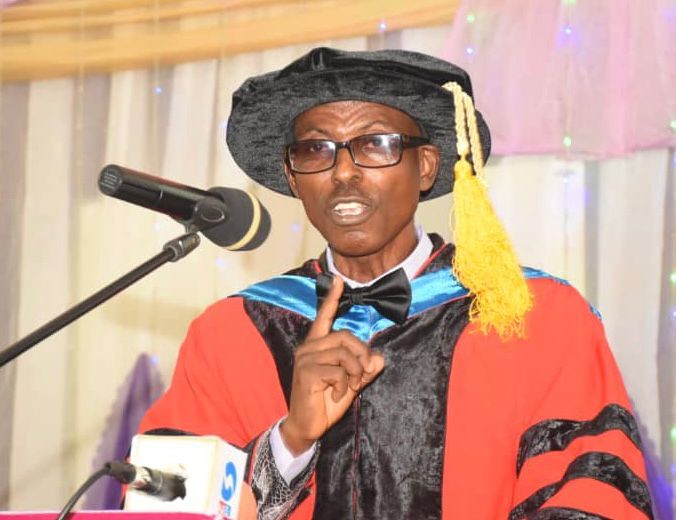
A renowned scholar in Educational Management, Professor Akinrotimi Oyetakin, has sounded a stark warning about the looming collapse of Nigeria’s tertiary education system due to what he described as a “dangerous financial disequilibrium.”
Delivering the 42nd Inaugural Lecture of Adekunle Ajasin University, Akungba Akoko, titled “Cost Explosion and Expenditure Implosion of Tertiary Education: Equilibrium Heresies in Motion”, Prof. Oyetakin lamented the growing gap between the skyrocketing costs of tertiary education and the declining funding commitments from both government and other stakeholders.
“There are no free meals anywhere in the world. Free education, in its real sense, is not free. Someone somewhere pays for it,” Prof. Oyetakin stated. “Therefore, based on the benefiter-pay principle and the tenets of fiscal justice, every stakeholder must contribute meaningfully to funding education.”
He explained that while Nigeria has made some investments in education, they remain grossly inadequate to meet the financial demands of 21st-century tertiary education. He characterized the imbalance as an “equilibrium heresy,” warning that it has critically weakened the quality and sustainability of the nation’s higher education.
“A flying bird (cost) versus a flying butterfly (funding) must be critically examined. Until we achieve true equilibrium, quality education will remain elusive,” he warned.
Proposed Solutions:
Prof. Oyetakin advocated a strategic recalibration of the funding model, urging the diversification of income streams. He called on universities to enhance their Internally Generated Revenue (IGR) through consultancy, commercialization of research, and partnerships with private investors.
“Every Naira earned through IGR is a value that could have been lost. Managements should adopt a profit-sharing formula attractive enough to motivate departments and units responsible for revenue generation,” he advised.
He proposed the establishment of the Education Emergency Relief Agency of Nigeria (EERAN) to handle educational disruptions caused by insecurity and disasters. He also recommended the adoption of Artificial Intelligence (AI) in university facility management and the introduction of a public-private ‘Adapt-a-School’ programme to bolster infrastructure development.
Additionally, he called for a minimum of 20% annual budgetary allocation to education at both federal and state levels, describing the current allocations as “abysmally low.”
“The Government and Stakeholders should devise a policy to encourage all employed alumni of every tertiary institution to assist their alma mater in infrastructural development. This policy will enable alumni to pay back some tokens and not just through gifts as it is generally done.”
Policy and Curriculum Overhaul Urged
Prof. Oyetakin also criticized the proliferation of non-viable academic programmes and institutions, calling for a strategic de-accreditation of courses with low economic value and poor labour market outcomes.
“We must apply the principle of economies of scale to ensure financial prudence and academic relevance. Non-profitable academic programmes should be discarded to reduce wastages,” he said. “Various studies have revealed that some courses in tertiary institutions with low economic returns are no longer profitable. Such programmes should be discarded or redesigned.”
He challenged the current overemphasis on academic qualifications as proof of productivity, denouncing what he referred to as “credentialism” and the screening hypothesis.
“Most developed nations are moving away from this theory with the belief that certificate acquisition at times is not concomitant with productivity,” he argued. “Most people cheat to get paper qualifications, which does not necessarily transform into a high level of productivity. Also, the screening process must not be politically rigorous where the best could turn out to be the last.”
Academic Excellence Celebrated
In his opening remarks, Vice Chancellor of Adekunle Ajasin University, Professor Olugbenga Ige, described the lecture as both an “academic discourse and a celebration of a life steeped in research, teaching, service, and impact.”
Prof. Ige commended Prof. Oyetakin for his “steadfast devotion to the pursuit of knowledge, exemplary service to the university, and outstanding scholarly contributions to the field of Educational Management.”
This report highlights the urgent need for collaborative action and visionary reforms in Nigeria’s educational sector, as echoed by Prof. Oyetakin, to avert a looming crisis and secure the future of quality tertiary education.