Editorial – Roving Reporters
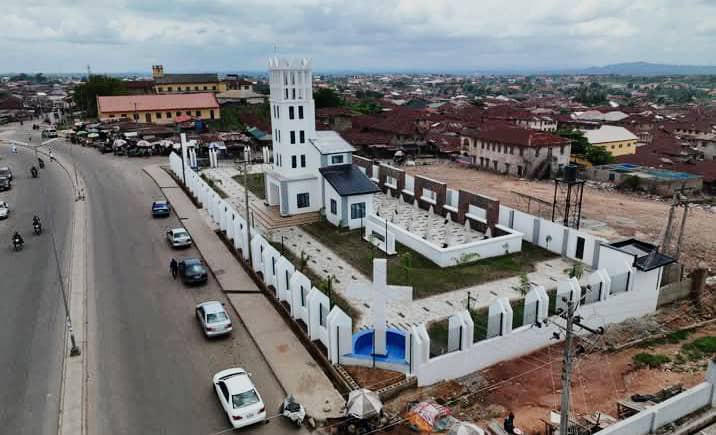
What began as a solemn promise to honour the dead has now morphed into a contentious symbol of political betrayal, cultural tension, and fractured communal trust. The demolition of the Owo Memorial Park—built in memory of the 41 innocent worshippers massacred at St. Francis Catholic Church on June 5, 2022—has not only reopened deep wounds but also exposed unsettling contradictions within Ondo State’s political and traditional institutions.
Despite the memorial’s original purpose as a symbol of healing, unity, and remembrance, it was reduced to rubble under a veil of cultural justifications and alleged land disputes. The fallout has since spiraled into a full-blown controversy involving the Ondo State Government, the Catholic Diocese of Ondo, the Olowo of Owo, and the widow of the late Governor Akeredolu, whose legacy appears to lie at the heart of the matter.
—
A Sacred Space Razed
The Catholic Diocese of Ondo’s official response to the demolition was measured yet firm. Bishop Jude Arogundade condemned the act as “unacceptable” and a painful reminder of the violence the community endured in 2022. His letter highlighted the park’s significance—not as a burial ground, but as a state-sanctioned, publicly commissioned site of memory.
The Church accused the state of failing to engage in proper dialogue prior to the demolition and questioned the cultural and legal motives offered. Indeed, as late as 2023, no objections had been raised when the project was constructed—under the full knowledge of the traditional rulers, including the Olowo himself. How did what was once acceptable suddenly become intolerable?
—
State’s Justification: Culture and Custodianship
The Ondo State Government, through the Chief Press Secretary to Governor Lucky Aiyedatiwa, responded with a counter-narrative: the land, it said, was not government-owned but belonged to AgroMore Limited, allegedly controlled by Oba Ajibade Gbadegesin Ogunoye before his ascension as Olowo. They pointed to cultural taboos and opposition from the palace, particularly due to the cenotaph’s proximity to the royal premises.
Yet this explanation raises more questions than it answers.
Why was the site originally approved under the Akeredolu administration? Why was no legal revocation made before construction began? And why did the demolition occur with such haste and without transparent public notice?
Moreover, critics, including the Owo Reformed Vanguard, have challenged the very basis of AgroMore’s claim to the land. They allege that ancestral families were displaced for the memorial, not a private firm, and that no Certificate of Occupancy exists to support the state’s narrative. The group even claimed that an earlier allocation to the Olowo was revoked by Governor Akeredolu after legal protests.
—
Legacy on Trial: The Akeredolu Factor
The late Governor Oluwarotimi Akeredolu’s vision for the Memorial Park was simple: to preserve the memory of victims and create a space of collective mourning and reflection. His widow, Betty Anyanwu-Akeredolu, has since emerged as one of the most vocal critics of the demolition, accusing the Olowo and Governor Aiyedatiwa of attempting to “rubbish” her husband’s legacy.
Her emotional visit to Akeredolu’s mausoleum and subsequent social media rebuttals—particularly her sarcastic takedown of traditionalists who placed curses on her—have polarized public opinion. Some see her as a courageous truth-teller. Others deem her remarks culturally insensitive.
But the core issue remains: a public memorial, initiated by a sitting governor in response to a massacre that shocked the nation, was demolished with questionable justification. That action, whether politically or culturally motivated, speaks volumes about the fragility of memory and power in Nigeria’s democratic spaces.
—
A Fragile Truce or Political Damage Control?
In what may be an attempt to restore calm, Governor Aiyedatiwa recently held a stakeholders meeting with Bishop Jude Arogundade, Anglican leaders, CAN officials, and representatives of the Olowo-in-Council. The outcome: the Church has “accepted” the decision to relocate the memorial and pledged support for a new cenotaph.
But this “resolution” does not absolve the government of its initial failings.
The meeting, while necessary, came after public outrage had already taken its toll, and after the emotional and cultural damage had been done. The Church’s decision to support relocation is less a victory for governance than an act of restraint—an attempt to salvage peace in a state already grappling with insecurity, political fragmentation, and cultural volatility.
—
The Bigger Picture: Memory vs. Power
The story of the Owo Memorial Park demolition is no longer just about a demolished monument. It is about the contest for narrative control. It is about who gets to define memory, and who gets to rewrite it. It is about the abuse of power—whether political, cultural, or spiritual—in the face of public grief.
Akeredolu’s vision was to enshrine collective memory in stone. The demolition has instead revealed how easily stone can be shattered by shifting loyalties, opaque governance, and selective respect for culture.
In the final analysis, the voices of the 41 slain parishioners may no longer be heard, but what remains loud and clear is the need for transparency, integrity, and a governance culture that honours the dead not only in words, but in actions.
The people of Owo—and all who share in their pain—deserve nothing less.
—
🖋️ Roving Reporters remains committed to exposing the facts, holding power accountable, and defending the public’s right to truth—even when it’s inconvenient.


1 comment
Excellent submission, the demolition was nothing but a heartless, mindless and wicked. Both Ayedatiwa and current Olowo are writing history not minding what the future will foretell for both. Apart from being disrespectful to the lost souls, it is a wreck less waste of government resources, only God knows how many millions was expended on the demolished cenotaph.What a wasteful government and what a selfish and lack of sacrifice ruler enthroned over Owo Kingdom. Whatever we do now, history will be our best judge.