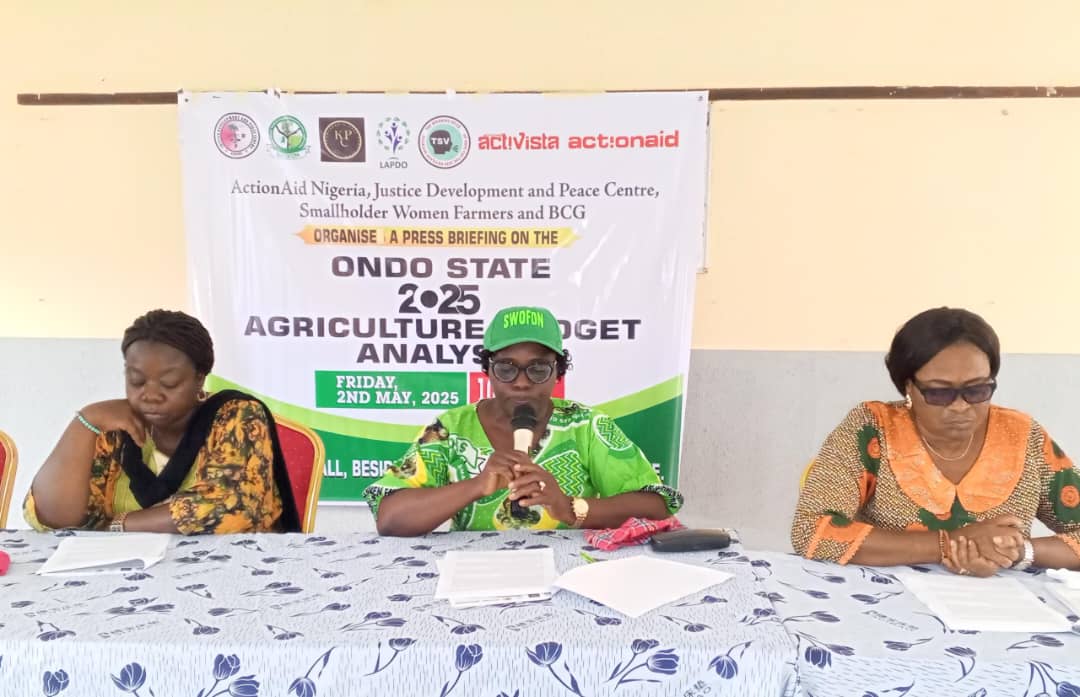
Stakeholders in the Agricultural sector have raised alarm over imminent hunger, poverty and unemployment in Ondo state as the state budget performance for agriculture fell short of expectations in 2024.
The stakeholders described as unfortunate and alarming that despite the fact that over N32 billion was approved for agriculture in the 2024 Budget in Ondo state, only N3billion was released, which amounted to just 9.89 percent of the approved fund.
This is contained in a report analysis by the Ondo state Budget Committee Group, BCG, and Small-scale Women Farmers Organization in Nigeria, SWOFON, on the state 2025 Agriculture Budget Analysis Observations and Recommendations.
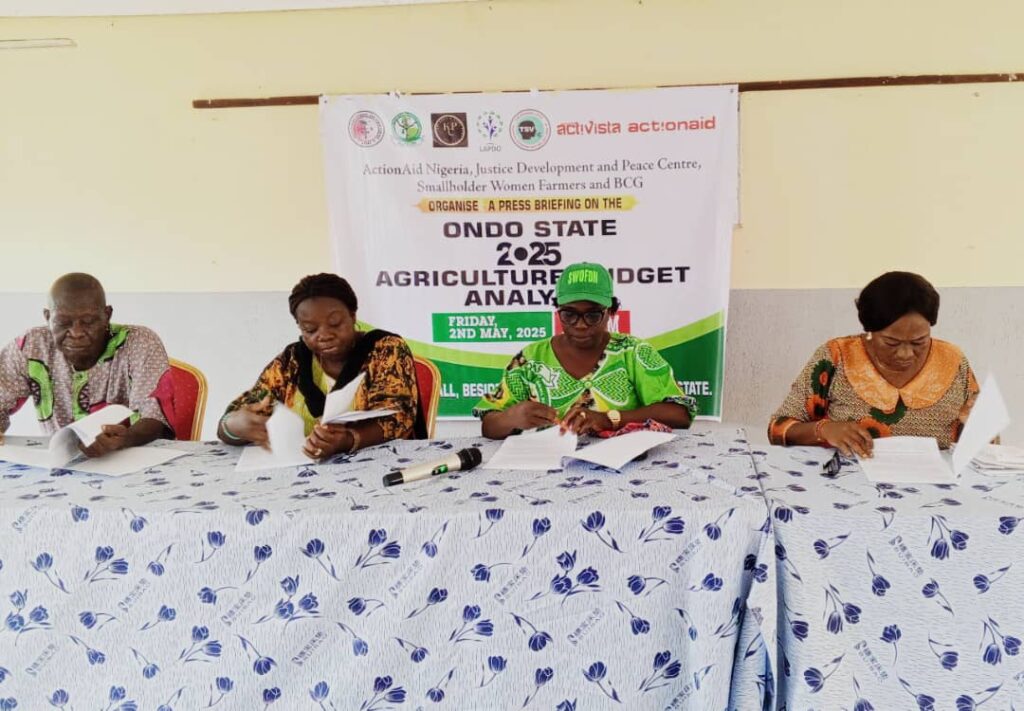
The Budget Committee Group carried out the annual analysis of the agriculture Budget of Ondo State in collaboration with Justice Development and Peace Centre, JDPC, and ActionAid Nigeria.
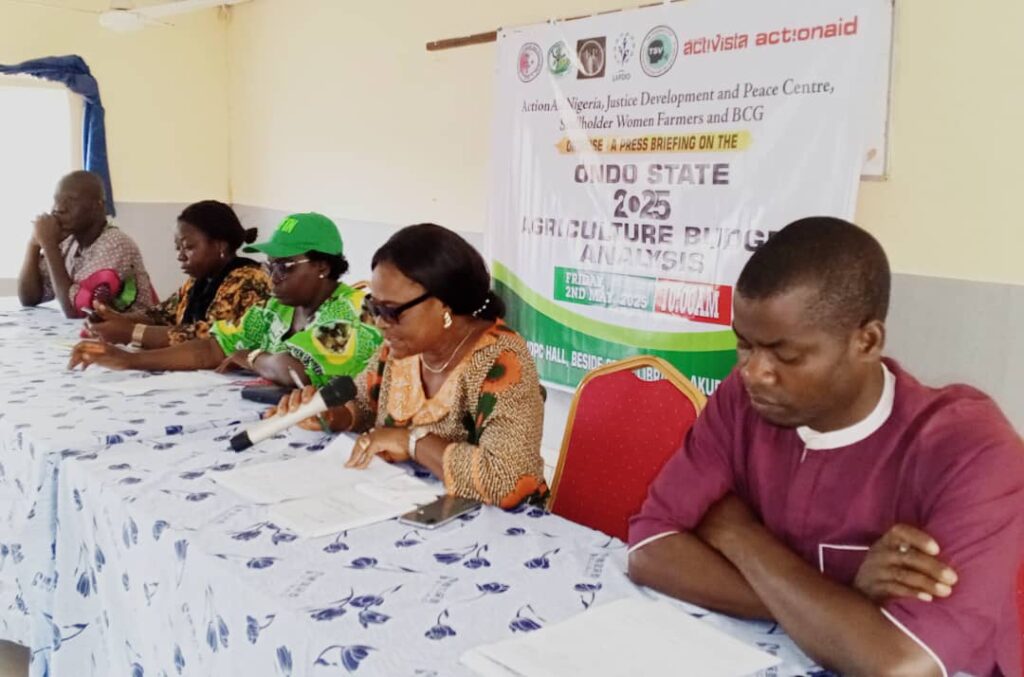
Reading the report before Newsmen in Akure the state capital, representatives of the Group said the indication of the 2024 budget on agriculture was that over N28billion was not released amounting to 90.11 percent, leaving a significant funding gap.
They said, “As a result, the performance of the Agricultural development sector in 2024 fell short of expectations.
“It did not support progress toward food security, resilient farming systems, or sustainable agriculture. If this trend continues, it could lead to serious consequences such as increased hunger, unemployment, and poverty particularly affecting small holder farmers especially women and young people in the state.”
They however called on the state government through “the state ministry of Budget, operating under the Ministry of Economic Planning and Budget, should ensure the release of detailed performance reports for each budget line item and specific MDAs. This will enhance transparency and accountability in the utilization of public funds within the agricultural development sector.”
Other Recommendations
There should be an increased and timely release of funds for capital expenditure, especially for critical agriculture programmes that can promote food security, resilience and transformative agricultural systems in the state. The low release rate of 9.98% in 2024 is worrisome and should be addressed to ensure projects are properly funded and implemented on time.
We recommend that vital departments and projects, like the Agro-Climatological and Ecological projects, receive the necessary funding for implementation. These projects, such as weather forecasting services for farmers, are essential for improving farming practices, particularly for smallholder women farmers.
The state government should allocate at least 10% of its annual budget to agriculture, in line with the Maputo/Malabo Declaration, to ensure at least 6% annual growth rate in compliance with the CAADP framework.
We suggest that the government should continue to prioritize capital expenditure for agriculture to ensure the effective implementation of projects that can drive agricultural development in the state. Even slight reductions in capital allocations, like the 0.63% drop from 2024 to 2025, should be avoided in the subsequent years.
The government should ensure that the Rural Access and Agricultural Marketing Project (RAAMP) is properly implemented, since it has the highest percentage allocation from the 2025 agriculture capital expenditure. In addition, observation from the past allocations have not yielded sufficient results in terms of rural roads and market accessibility, which limits the impact of the agricultural budget.
There needs to be a significant improvement in extension services delivery, particularly to smallholder women farmers who need improvement in all ramifications of agricultural practices. This effort includes increasing the number of extension agents, providing transportation (like motorcycles), and ensuring that these agents have the resources and technicalities to effectively assist farmers in rural areas.
. We recommend that the government clearly specify whether the N78,360,000.00 allocated to the Commercial Agriculture Credit Scheme (CACS) is targeted at smallholder farmers or larger commercial enterprises. Furthermore, we urge that this allocation be increased to ensure it provides adequate and meaningful financial support to smallholder farmers, with particular attention to the needs of women farmers.
We recommend that the government take deliberate and responsive actions to address the pressing challenges faced by smallholder women farmers, including limited access to land, inadequate market linkages, and insufficient post-harvest support. The 2025 budget should prioritize and expand initiatives that empower women farmers and enhance their active participation in the agricultural sector.
Ondo state government should always specify where agricultural projects will be implemented in the budget. This will improve accountability and ensure that funds are used effectively to enhance growth and development in the agriculture sector.
More funding should be allocated to agricultural research and development. Investing in research and development will support improvements in crop varieties, pest control, sustainable farming practices, and post-harvest management.
The state government should allocate more resources to irrigation projects, especially in light of climate change and unpredictable rainfall. The 2025 budget allocation of N20,000,000 for irrigation is insufficient and should be expanded to cover more local governments.
. We recommend that the government should support farmers in the procurement of labour-saving irrigating machines such as drip irrigation, sprinkler and solar power irrigation pumps for communities who practice cluster farming.
. Post-harvest losses reduction support system requires Ondo State government to:
(1) Scale up funding by providing small-scale storage and processing technologies like metal silos, plastic bags etc.
(2)Support farmers by creating market linkages with buyers to reduce delays in selling farm produce, especially the perishable ones.
(3) Ensure that adequate training and capacity building is constantly provided to support small-scale farmers especially youths and women in agriculture to enable them to learn basic methods of preserving their produce from rotten.
(4) Provide good road network between the urban and rural communities (especially roads that lead to farmlands) to ease the burden of transporting farm produce from the farm to the cities.
We recommend that government should strengthen the input supply chain (from manufacturer/dealer to the farmers), promote subsidized organic input supply for farmers with full consideration of proximity to enable more accessibility of the smallholder women farmers who are majorly domiciled in the hard-to-reach communities within the state.
The present economic situation in the country is limiting the financial capacity of the majority of the Smallholder women farmers to have sustainable and improved farming practices. In the light of the above, we recommend that the state government should strengthen collaborations with relevant financial institutions that can support farmers with credit facilities of low interest rates for improve wellbeing and continued farming practices, leading to food security and resilient agricultural practices in the state.
We recommend that government should consider the inclusion of youth and women in agriculture as investment that transcends beyond the scope of time. We strongly believe that with more budgetary allocation, capacity building, training and enabling environment through policy formulation and implementation for youths and women, Ondo State agricultural sector becomes a safe haven for all.
We recommend that government should urgently strengthen the state’s security architecture to halt the extrajudicial killings and kidnap happening in communities, especially Akure-North local government area of the state, where most victims are farmers.