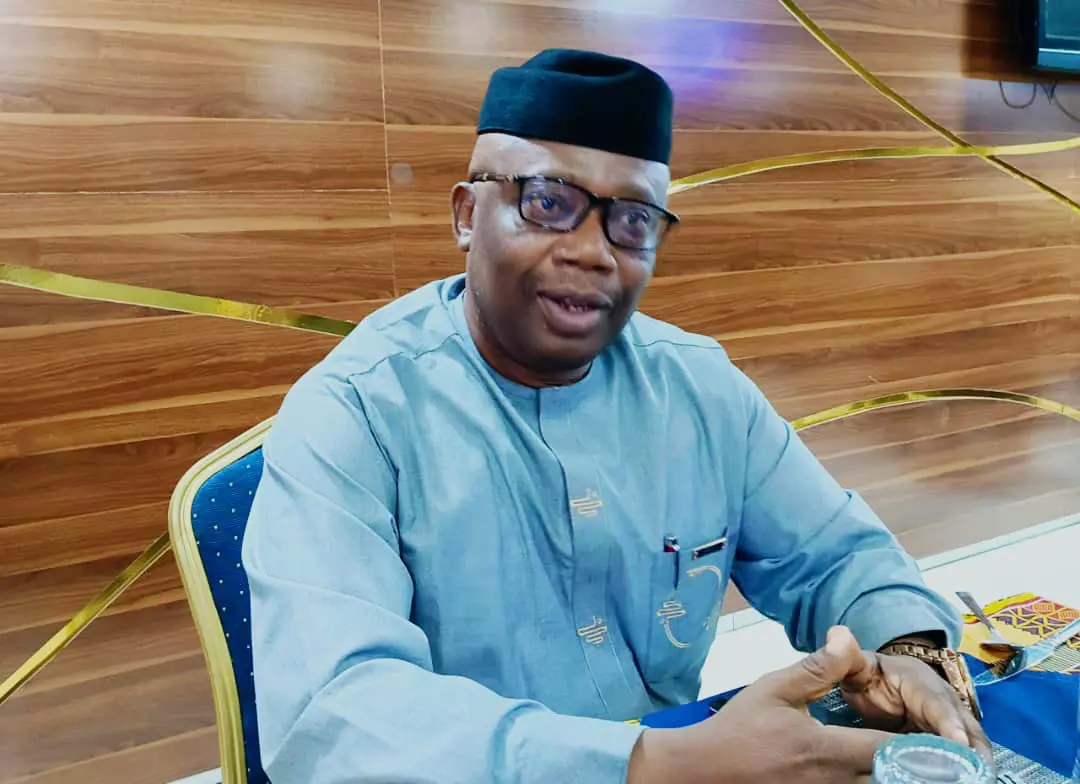
— urges Ondo North to demand legislative accountability
A legal practitioner and voter in Ondo North Senatorial District, Wale Obanigba, has argued that Senator Jide Ipinsagba has not demonstrated sufficient legislative impact to merit re-election, insisting that constituency handouts and empowerment programmes cannot substitute for constitutional responsibilities.
In a statement dated February 16, 2026, Obanigba said the ongoing debate over the senator’s performance was triggered by his earlier article of February 14, 2026, in which he challenged what he described as a “stubborn misconception” that constituency projects and episodic empowerments define legislative excellence.
According to him, the debate drew responses from Sola Ajisafe, Esq., who used an “Amukun” analogy to defend the senator, as well as from the senator’s aides who listed several constituency interventions as achievements.
However, Obanigba maintained that the responses failed to address what he termed the “constitutional test” of representation.
He stated that under the 1999 Constitution (as amended), the core duties of a senator are lawmaking, oversight, and strategic federal representation — not the distribution of JAMB forms, fertilisers or other ad hoc empowerment items.
“Constituency projects are executive-funded insertions in appropriation, implemented by ministries and agencies, not proof of legislative excellence,” he said, arguing that equating such interventions with performance lowers the constitutional standard.
Obanigba said Ajisafe’s latest intervention had sharpened the debate by raising what he described as fundamental democratic questions: “Where is the legislative imprint? Where is the committee-driven influence? Where is the measurable national consequence of representation?”
He queried how a senator translates committee leadership into concrete outcomes, particularly in oversight breakthroughs, policy reforms and budgetary gains capable of reshaping lives at scale.
Drawing comparisons within the Ondo State delegation, Obanigba cited Senators Adeniyi Adegbomire and Jimoh Ibrahim as examples of visible committee leadership and inter-parliamentary engagement that have generated national discourse and infrastructure conversations.
“Influence is audible in plenary, traceable in committees, and legible in outcomes,” he said.
He argued that the defence mounted for Ipinsagba relied largely on a catalogue of interventions that do not meet constitutional benchmarks. He questioned the existence of a budget line and implementation pathway for the proposed ICT University frequently referenced by the senator’s supporters.
Obanigba also pointed to the senator’s positions as Chairman of the Senate Committee on Public Procurement and Vice Chairman of Petroleum (Downstream), describing them as two of the chamber’s most consequential committees.
“Where are the procurement reforms, the downstream interventions, the oversight moments that altered outcomes for Ondo North or Nigeria at large?” he asked.
He further cited the Owo–Ikare corridor, which he described as arterial to Ondo North, as remaining largely unattended, while security concerns in border communities have yet to receive sustained national focus. He added that education infrastructure gaps persist despite the distribution of forms.
“These are not solved by symbolism; they are solved by legislative leverage,” he said.
Obanigba dismissed arguments that systemic limitations excuse performance gaps, insisting that holding office confers agency.
“If the system is flawed, the Senator’s duty is to contest it with skill through coalitions, negotiations, amendments, oversight hearings, and strategic bargaining. Silence or modest gestures presented as milestones cannot be recast as structural reform,” he stated.
He also contended that comparisons with other first-term senators do not favour the defence, noting that several of Ipinsagba’s peers have converted adversity into visibility and influence.
“Re-election is not an entitlement; it is a renewal earned by consequentiality — by a record that shows how power was used, not merely possessed,” he said.
Obanigba concluded that Ondo North must “raise the standard” by demanding legislative imprint and representation that speaks, negotiates, oversees and delivers measurable outcomes.
“Until that standard is met, Senator Ipinsagba is not worthy of re-election,” he declared.