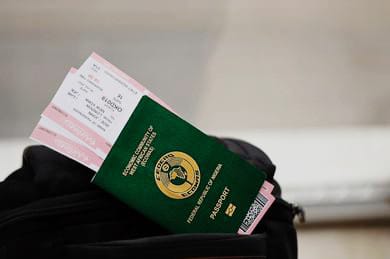
For millions of Nigerians, flying has quietly slipped beyond reach—not because planes have stopped flying, but because 54 different taxes and charges now swallow up more than one-third of every ticket sold.
From students trying to get home for the holidays, to traders shuttling goods between cities, to families escaping insecurity on the highways, the story is the same: air travel is becoming a privilege for the few.
At the heart of the crisis is a growing list of levies—some visible, many hidden inside ticket prices—that airlines say they have no choice but to pass on to passengers.
A Guardian investigation found that only six of these charges appear on tickets, while 48 others are embedded in airline costs, eventually landing on the laps of ordinary Nigerians.
For domestic flights, NCAA’s charges alone add up to N18,000–N25,000 per passenger, before fuel, airport fees, and new security levies are added. For international travellers, the total can reach $180, making Nigeria one of the most expensive places in the world to buy a ticket.
‘A Family of Three Needs N450,000 Just to Travel’
Gbemisola Akinboro, Managing Director of Scribe Global Services, sees the human impact daily.
“Families have simply dropped out of flying,” he said. “A family of three needs about N450,000 for a one-way domestic trip. Many are going back to the roads—even with the insecurity.”
For many Nigerians, the decision is no longer about convenience. It’s about survival.
A single mother travelling from Abuja to Lagos for medical treatment told The Guardian that she had stopped flying altogether.
“How can I pay N170,000 for a one-hour flight when my entire salary is N120,000?” she asked.
‘Passengers Now Pay More Taxes Than the Fare Itself’
Aviation experts say Nigeria has one of the heaviest aviation tax burdens globally.
Kingsley Nwokoma of Cargolux Airlines warned that passengers in Nigeria often pay more in taxes than the actual base fare.
“This is not normal. Government is choking travellers,” he said.
Airlines Also Struggling
Behind the scenes, airlines are also hurting.
After paying for fuel, which takes up 40% of revenue, and settling over 50 different government charges, many airlines are barely staying afloat.
Several carriers have quietly reduced frequencies, while others cannot acquire more aircraft due to rising operating costs and forex shortages.
Capt. Ado Sanusi of Aero Contractors described aviation as “one of the most taxed industries in Nigeria,” saying this is now directly killing demand.
“When people stop flying, the whole sector shrinks,” he said. “Ground handlers, caterers, engineers—everyone suffers.”
Nigeria vs. The Rest of the World
While Nigerians grapple with 54 charges, other countries have fewer and cheaper levies:
Ghana: 2 ticket charges
Kenya: $4.60 domestic passenger fee
South Africa: $5.78 tax for regional flights
U.S.: 7.5% tax + airport fee
U.K.: Air Passenger Duty only
Nigeria’s burden is two to three times higher than most countries.
Calls for Urgent Reform
Aviation analyst Chris Amokwu said the system is pushing the industry toward collapse.
“About 30–40% of ticket revenue goes to taxes. Another 40% goes to fuel. How can airlines survive? How can passengers cope?” he asked.
Operators are urging the Federal Government to create a single, transparent, harmonised tax structure and stop seeing airlines as “cash cows.”
Until that happens, many Nigerians fear that flying may soon become an activity reserved only for government officials, big corporations, and the very wealthy.
GUARDIAN NEWSPAPER