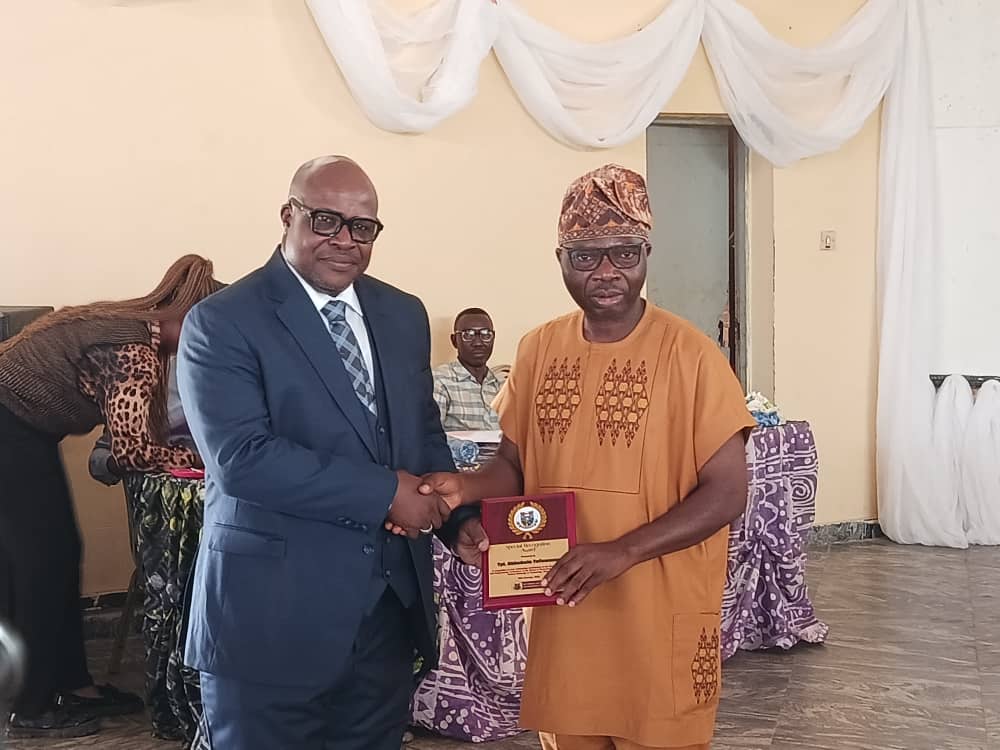
Abimbola Tofowomo, a Town Planner and Director of the Department of Master Plan at the Ondo State Ministry of Physical Planning and Urban Development, has been honoured with the 2026 School of Environmental Technology (SET) Conference Sponsors Special Recognition Award of the Federal University of Technology, Akure (FUTA).
Tofowomo received the award on Wednesday at the 2026 SET Annual Lecture and Postgraduate Conference held at the T.I. Francis Auditorium, FUTA. The conference, themed “Climate Resilient Communities: The Role of Built Environment Professionals in the Global South,” brought together stakeholders and professionals in the built environment sector.
Speaking after receiving the award, Tofowomo described the honour as a special recognition of his contributions to the postgraduate school and its activities.
“I can say that the award given to me today is a special recognition in terms of my contribution to the efforts and works of the postgraduate school in FUTA, and I am feeling very elated,” he said.
He also charged fellow professionals to uphold integrity and diligence in their practice, urging them to mentor and support upcoming planners to strengthen their professional foundation and growth.
In her opening address, Chairperson of the Organising Committee and Professor of Architecture, Dorcas Ayeni, called on built environment practitioners across the country to promote climate resilience in their projects, support evidence-based regulations and invest in local solutions.
Ayeni noted that countries in the Global South are at a critical crossroads, grappling with rapid urbanisation and worsening climate impacts. She observed that urban populations are projected to double by 2050, even as cities contend with devastating floods in Lagos and other parts of Nigeria, prolonged droughts threatening food security, rising temperatures and coastal erosion affecting vulnerable communities.
“The statistics are sobering; climate change could push an additional 100 million people in the Global South into extreme poverty by 2030, and our infrastructure deficit is estimated at several billion dollars annually,” she said.
Despite the challenges, Ayeni expressed optimism, stressing that built environment professionals hold the key to transformative solutions.
“As architects, urban planners, quantity surveyors, estate managers, industrial designers, textile designers, surveying and geoinformatics experts and builders, we shape the physical spaces where life unfolds. Every building we design and construct, every city we plan, and every role we play either perpetuates vulnerability or builds resilience. Our input must be a fortress against the climate change of tomorrow,” she added.
Also speaking, the Vice-Chancellor of FUTA, Professor Adenike Oladiji, described the conference theme as timely and profoundly relevant. Represented by the Deputy Vice-Chancellor (Development), Professor Sunday Oluyamo, she said the impacts of climate change across the Global South — including extreme weather events, environmental degradation, housing insecurity and infrastructure stress — are no longer distant projections but lived realities.
According to her, the situation demands context-specific, innovative, inclusive and sustainable solutions.
“The built environment sits at the heart of this conversation. We shape the spaces in which people live, work and interact. It is therefore imperative that built environment professionals rise to the responsibility of designing and managing communities that can withstand, adapt to and recover from climate-induced shocks,” she stated.